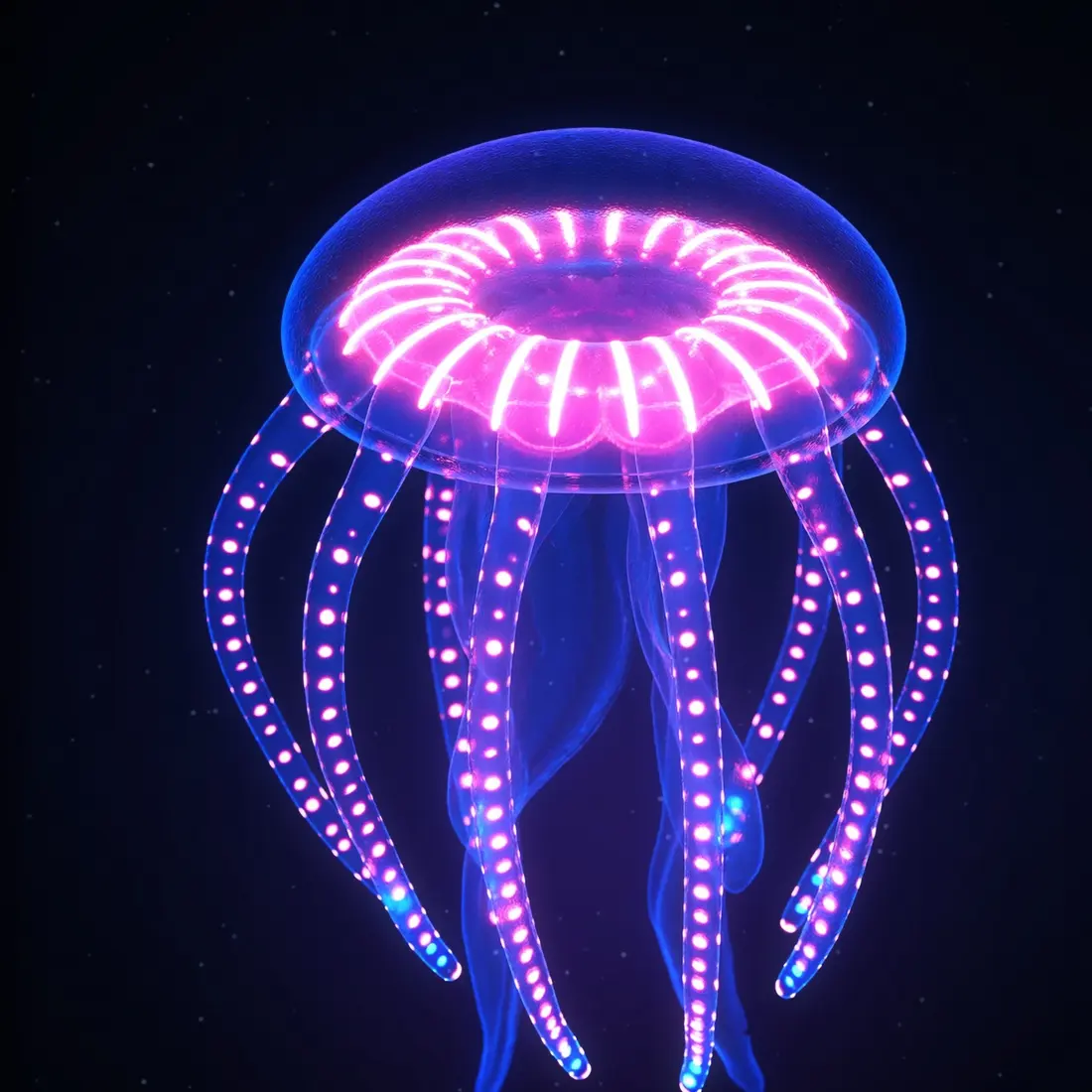
Atolla Jelly
Atolla wyvillei Haeckel, 1880
Plates and text by Firoiu Dan Nicolae
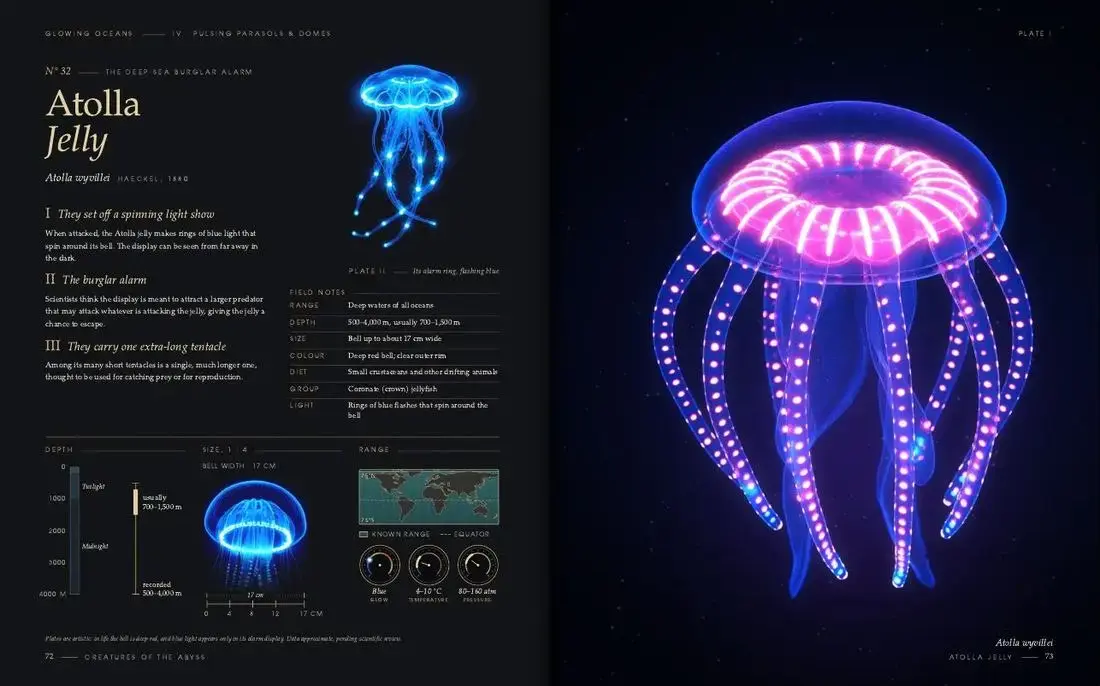
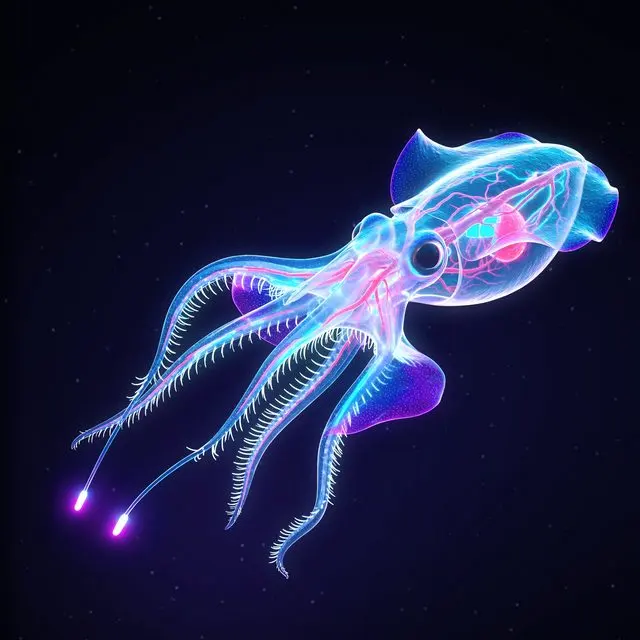
Usually found at 700–1,500 m. From Glowing Oceans: An Atlas of Glowing Living Forms, where every creature has two facing pages: what is known on the left, the full plate on the right.
Three facts
They set off a spinning light show
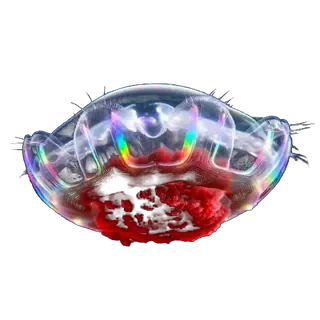
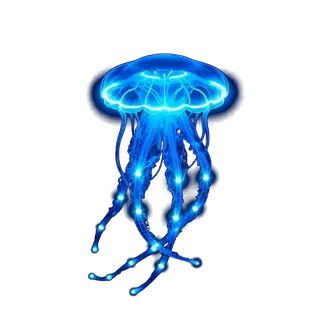
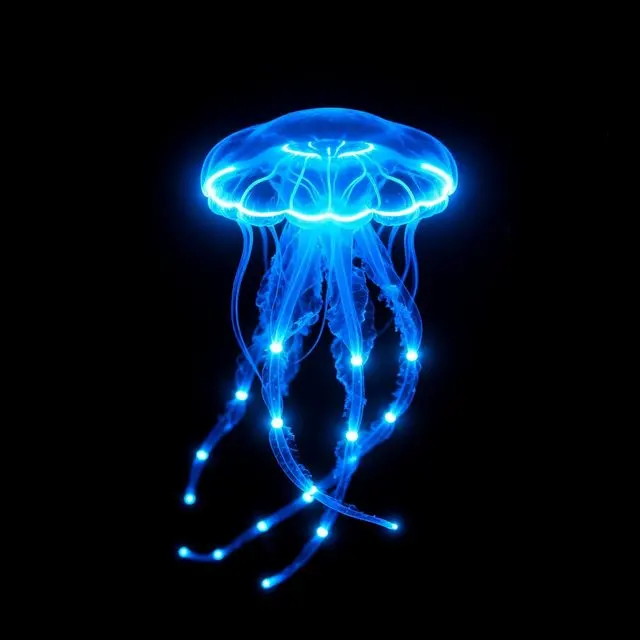
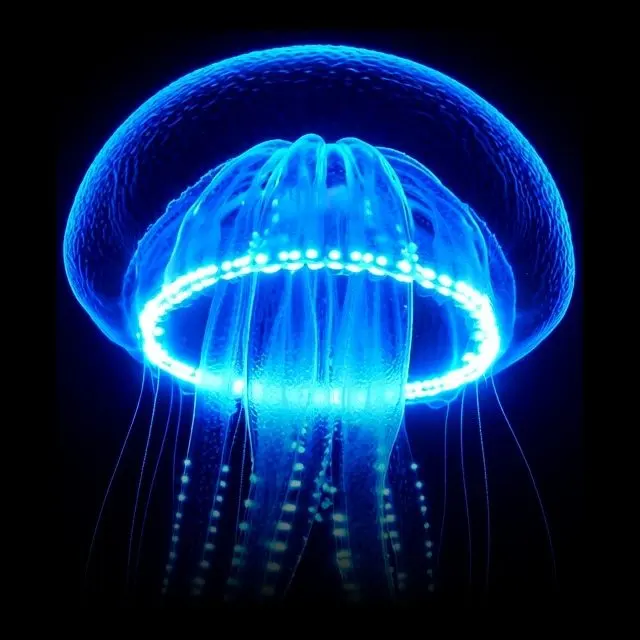
When attacked, the Atolla jelly makes rings of blue light that spin around its bell. The display can be seen from far away in the dark.
The burglar alarm
Scientists think the display is meant to attract a larger predator that may attack whatever is attacking the jelly, giving the jelly a chance to escape.
They carry one extra-long tentacle
Among its many short tentacles is a single, much longer one, thought to be used for catching prey or for reproduction.
Field notes
| Range | Deep waters of all oceans |
|---|---|
| Depth | 500–4,000 m, usually 700–1,500 m |
| Size | Bell up to about 17 cm wide |
| Colour | Deep red bell; clear outer rim |
| Diet | Small crustaceans and other drifting animals |
| Group | Coronate (crown) jellyfish |
| Light | Rings of blue flashes that spin around the bell |
The plates are artistic interpretations and do not show the true colours of the living animal. Every measurement has a source, printed at the back of the book.
More plates
Where it lives
The Atolla jelly is usually found at 700–1,500 m, in the twilight and midnight zones: the layer where only a faint blue dusk remains. It has been recorded from 500–4,000 m, across the twilight and midnight zones. Its range: Deep waters of all oceans.
Below about 200 metres only a blue dusk remains, and below a thousand metres sunlight is gone altogether. Every creature in Glowing Oceans carries the same depth sign, so you can see at a glance how deep it lives compared with the others.
In the book
In the book, the Atolla jelly is creature no. 32 of 101. It belongs to family IV, Pulsing Parasols & Domes: bells and cloaks that open and close, the jellies and the vampire squid. The families are grouped by shape, not by family tree, so the book reads as a gallery.
Its two pages hold three facts written to be read aloud, the field notes, a life-size view, a map of its range, and dials for its glow, water temperature and pressure. Every fact is traced to a source printed at the back of the book.
Related creatures
Author and artist of Glowing Oceans and the Glowing Series. He wrote the book’s text, drew its 303 plates, and designs the exhibitions that grow out of it.
More about Firoiu Dan Nicolae →