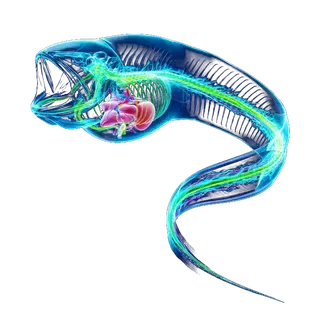
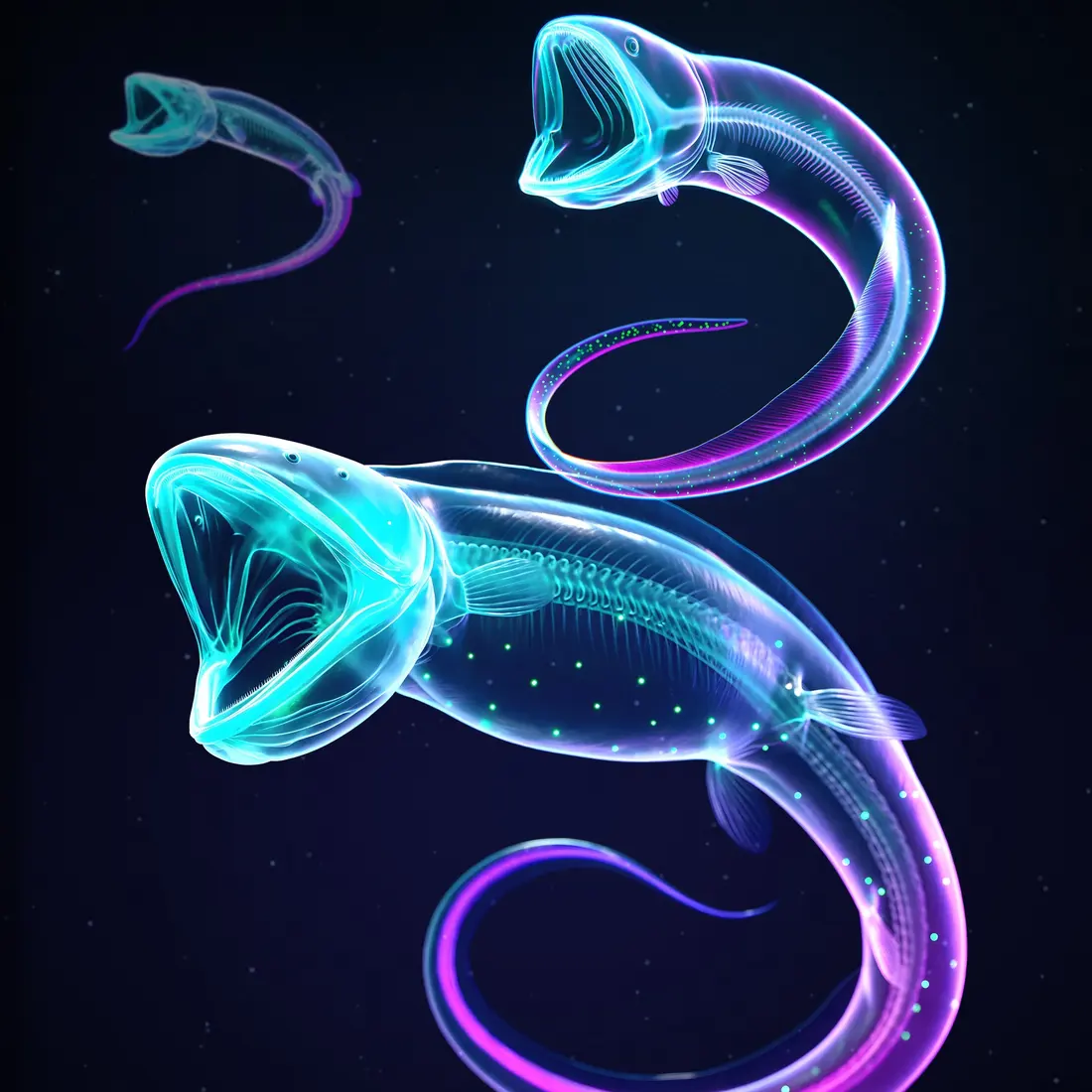
Pelican Eel
Eurypharynx pelecanoides Vaillant, 1882
Plates and text by Firoiu Dan Nicolae
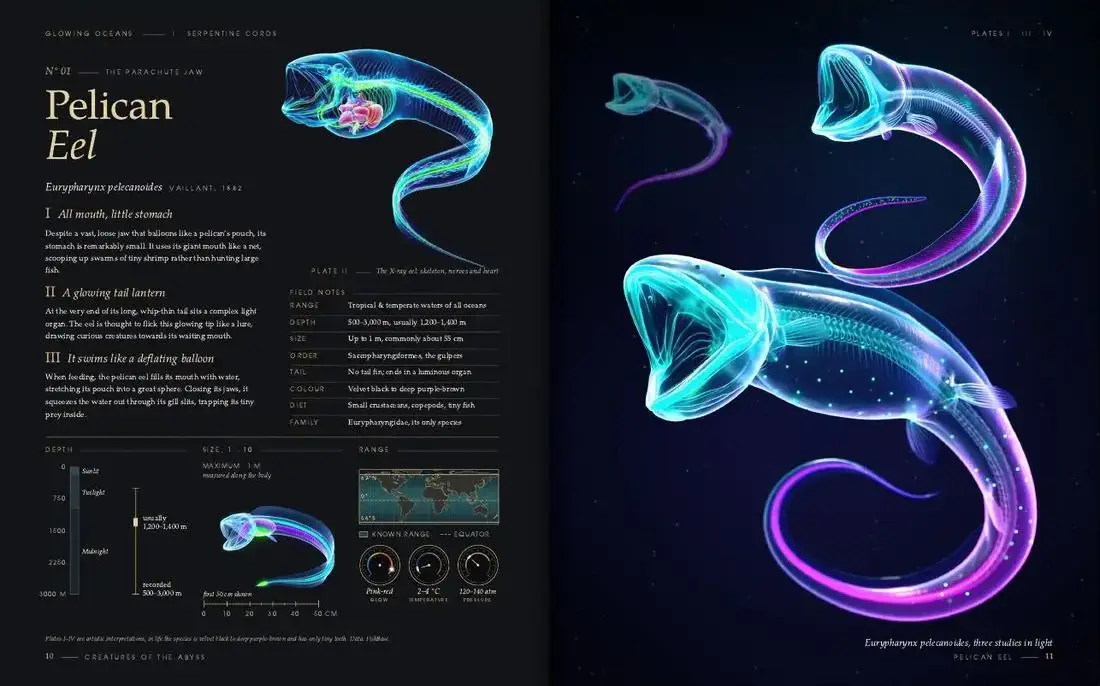
Usually found at 1,200–1,400 m. From Glowing Oceans: An Atlas of Glowing Living Forms, where every creature has two facing pages: what is known on the left, the full plate on the right.
Three facts
All mouth, little stomach
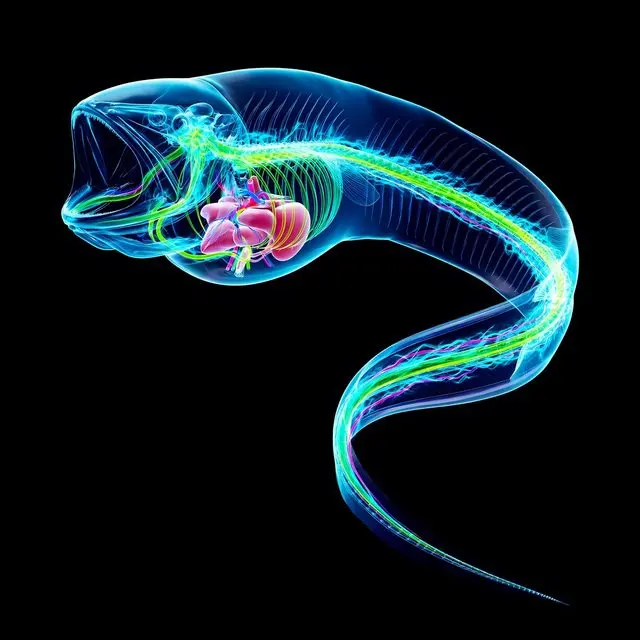
Despite a vast, loose jaw that balloons like a pelican’s pouch, its stomach is remarkably small. It uses its giant mouth like a net, scooping up swarms of tiny shrimp rather than hunting large fish.
A glowing tail lantern
At the very end of its long, whip-thin tail sits a complex light organ. The eel is thought to flick this glowing tip like a lure, drawing curious creatures towards its waiting mouth.
It swims like a deflating balloon
When feeding, the pelican eel fills its mouth with water, stretching its pouch into a great sphere. Closing its jaws, it squeezes the water out through its gill slits, trapping its tiny prey inside.
Field notes
| Range | Tropical & temperate waters of all oceans |
|---|---|
| Depth | 500–3,000 m, usually 1,200–1,400 m |
| Size | Up to 1 m, commonly about 55 cm |
| Order | Saccopharyngiformes, the gulpers |
| Tail | No tail fin; ends in a luminous organ |
| Colour | Velvet black to deep purple-brown |
| Diet | Small crustaceans, copepods, tiny fish |
| Family | Eurypharyngidae, its only species |
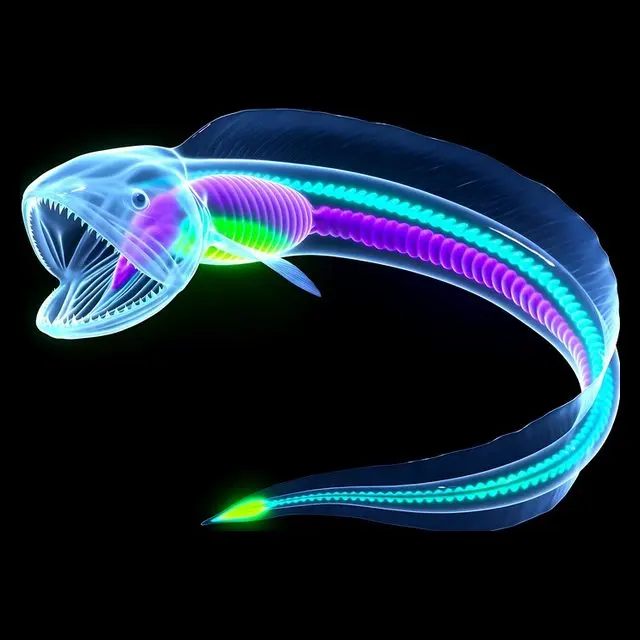
The plates are artistic interpretations and do not show the true colours of the living animal. Every measurement has a source, printed at the back of the book.
More plates
Where it lives
The pelican eel is usually found at 1,200–1,400 m, in the midnight zone: the layer where no sunlight reaches and the only light is made by living things. It has been recorded from 500–3,000 m, across the twilight and midnight zones. Its range: Tropical & temperate waters of all oceans.
Below about 200 metres only a blue dusk remains, and below a thousand metres sunlight is gone altogether. Every creature in Glowing Oceans carries the same depth sign, so you can see at a glance how deep it lives compared with the others.
In the book
In the book, the pelican eel is creature no. 1 of 101. It belongs to family I, Serpentine Cords: long, thin bodies that coil and ribbon through the water: eels, siphonophores, worms. The families are grouped by shape, not by family tree, so the book reads as a gallery.
Its two pages hold three facts written to be read aloud, the field notes, a life-size view, a map of its range, and dials for its glow, water temperature and pressure. Every fact is traced to a source printed at the back of the book.
Related creatures

Author and artist of Glowing Oceans and the Glowing Series. He wrote the book’s text, drew its 303 plates, and designs the exhibitions that grow out of it.
More about Firoiu Dan Nicolae →